New Report Identifies Gap, Offers Practical Solutions to Meet Seniors’ Growing Housing and Care Needs
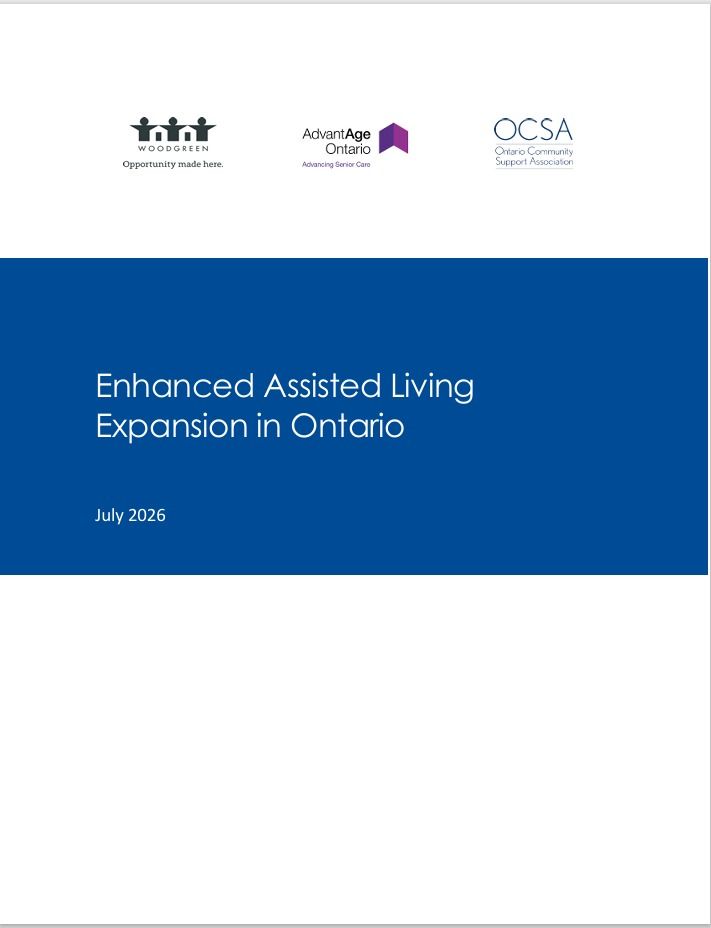
"Enhanced Assisted Living Expansion in Ontario” report also calls for government support to expand unique models of care.
Toronto, Ontario (October 1, 2026) – Following the release of a new report that identifies a critical gap in Ontario’s housing and care continuum for older adults, WoodGreen Community Services, the Ontario Community Support Association (OCSA) and AdvantAge Ontario are calling on the provincial government to support the expansion of Enhanced Assisted Living (EAL) models.
EAL provides an option of care for seniors who require reliable access to wrap-around community care, personal support services, and stable affordable housing environments to meet increasing care needs while promoting independence, safety, improved quality of life and social connection. EAL often consists of small or clustered living spaces, with 24/7 personal support workers that support Activities of Daily Living, including cooking, cleaning or bathing.
EAL offers a practical, affordable community-based solution for older adults whose health care needs fall between home care and long-term care (LTC), and reduces the intense pressure on home care, hospitals, and LTC settings. It is also half the price of LTC to taxpayers and significantly less expensive than hospitalizations, which costs more than $700 per client per day, resulting in substantial savings to the system.
The report, titled Enhanced Assisted Living Expansion in Ontario, identifies a growing gap for aging seniors in the current care system and offers examples of practical EAL solutions that can alleviate pressure on the health care system.
WoodGreen’s Cluster Care and EAL model helps seniors remain in the community longer, thus avoiding a premature move to LTC. Through this model, WoodGreen has diverted 83% of its residents permanently from LTC. Other EAL models featured in the report include Bruyère Health Besserer Place in Ottawa, which helped 168 residents avoid emergency room visits over a six-year period and Loft Community Services Back to Home Model, which reduced hospital readmission rates by over 85% among 29 of its clients, generating significant reductions in hospitalization costs and health care system savings.
These models can provide affordable Rent-Geared-To-Income housing, such as the 30-unit Sunnyside Campus of Care in Waterloo Region, and can offer cost-effective care from approximately $92 (Bruyere Health) to $169 per client per day (Ewart Angus SPRINT Home Model), inclusive of staffing and essential program costs.
Overall, EAL models reduce pressure on the health system in a more cost-effective manner by helping older adults avoid unnecessary hospital visits and delay or avoid premature admission to long-term care. Without EAL options, older adults are often stuck in hospital after acute care or enter LTC before it is clinically necessary.
Currently, there is a lack of reliable and sustainable funding for organizations to accelerate and scale EAL across the province. This new report calls for EAL to be a provincially defined and supported model for housing and health care, with dedicated operating funding, to support its growth.
Quotes
“Enhanced Assisted Living fills a critical gap in Ontario’s continuum of care by supporting older adults whose needs have outgrown traditional home care but who do not require long-term care. These models help seniors remain safely in their communities while easing pressure on hospitals and long-term care.”
-Lisa Levin, CEO, AdvantAge Ontario
“Ontario is undergoing significant demographic change, reshaping demand for housing, health, and home and community care. As the health system faces growing pressure, Enhanced Assisted Living such as Cluster Care provides essential housing and wrap-around personal supports that can help seniors remain independent longer and transition to long-term care when appropriate. Expansion of these models would enable community service providers to reach more of Ontario’s most vulnerable communities.”
-Anne Babcock, President & CEO, WoodGreen Community Services
“This report demonstrates that community support service organizations across the province are building innovative models that fill the gaps to keep seniors living well at home and in their community. Ontario now needs to recognize these models and provide sustainable operating funding so more older adults can access that support in their communities.”
-Lori Holloway, CEO, Ontario Community Support Association
“LOFT Community Services is proud to support and contribute to this important policy paper. As a leader in delivering integrated housing, health, and community supports for older adults with complex needs, we know that the right care in the right setting can be transformative. Enhanced Assisted Living represents an important opportunity to reimagine how we support aging adults—bringing together housing and care in a way that promotes dignity, empowers choice, and helps people continue living meaningful lives in the communities they value most.”
– Debra Walko, Chief Client Care Officer, LOFT Community Services.
“Enhanced Assisted Living is an innovative model that is already making a difference, demonstrating meaningful benefits for individuals while helping reduce pressures across the health care system. When people can access the right level of support in a community-based setting, they experience greater independence, dignity, and quality of life, while avoiding unnecessary hospital stays and premature transitions to long-term care. Additional investment in successful models such as Bruyère Health’s enhanced assisted living program could expand access to these proven programs, helping more people remain safely at home while reducing demand on hospitals and long-term care. By bringing partners together and investing in innovative models of care, we have a real opportunity to build a more responsive, sustainable, and person-centred health care system.”
-Melissa Donskov, Vice President, Residential and Community Care and Programs, Bruyere Health
“Ontario needs to expand proven models of community-based care so older adults can get the right support, in the right place, at the right time. The Ewart Angus SPRINT Home Model shows what’s possible when we bring care closer to home and now we need to build on that success and expand Enhanced Assisted Living models across the province.”
-Stacy Landau, Chief Executive Officer, SPRINT Senior Care
“The recognition of Sunnyside Supported Living in this report affirms what we see every day: when older adults have an affordable home, meaningful relationships, and responsive daily supports, they can live with greater independence, stability, and dignity in their community. Our experience has shown the value of housing options that help bridge the gap between episodic care at home and long-term care, and that are integrated with local health and community services. Models like these can help older adults age in place, stay connected, and access the supports they need as their needs change.”
– Julie Wheeler, Director, Seniors’ Services, Region of Waterloo
About the Organizations
WOODGREEN COMMUNITY SERVICES
WoodGreen is one of the largest social service agencies in Toronto, serving 40,000 people each year. We offer over 75 programs and services tackling the social determinants that affect the health and well-being of individuals in our community.
ADVANTAGE ONTARIO
AdvantAge Ontario is the voice of not-for-profit seniors’ care in the province, representing more than 530 providers of long-term care, seniors’ housing, supportive housing and community service agencies.
ONTARIO COMMUNITY SUPPORT ASSOCIATION
The Ontario Community Support Association (OCSA) is the leading voice for home and community care in Ontario, representing hundreds of not-for-profit organizations delivering both home care and community support services across the province. OCSA members provide essential services including nursing, personal support and therapies; Meals on Wheels, transportation, caregiver supports, and other programs that help people remain safely in their homes and communities. Serving over one million Ontarians each year, OCSA works with government and system partners to advance integrated, community-based care as a cornerstone of a sustainable health system.
Media Contacts
Chris Noone
Senior Manager, Communications and Member Services
AdvantAge Ontario
E: cnoone@advantageontario.ca
Chris Centeno
Manager, Media Relations, Paid Media & Thought Leadership
Woodgreen Community Services
E: media@woodgreen.org
Karla Sealy
Manager, Advocacy, Policy and Community Engagement
Ontario Community Supports Association
E: karla.sealy@ocsa.on.ca
Share
More Updates