

Communications
Thank you for your interest in OCSA's media room. Here, you will find statements and media releases issued by OCSA, as well as member bulletins providing important updates on issues impacting the home and community care sector.
Statements & Media Releases
"Enhanced Assisted Living Expansion in Ontario” report also calls for government support to expand unique models of care.
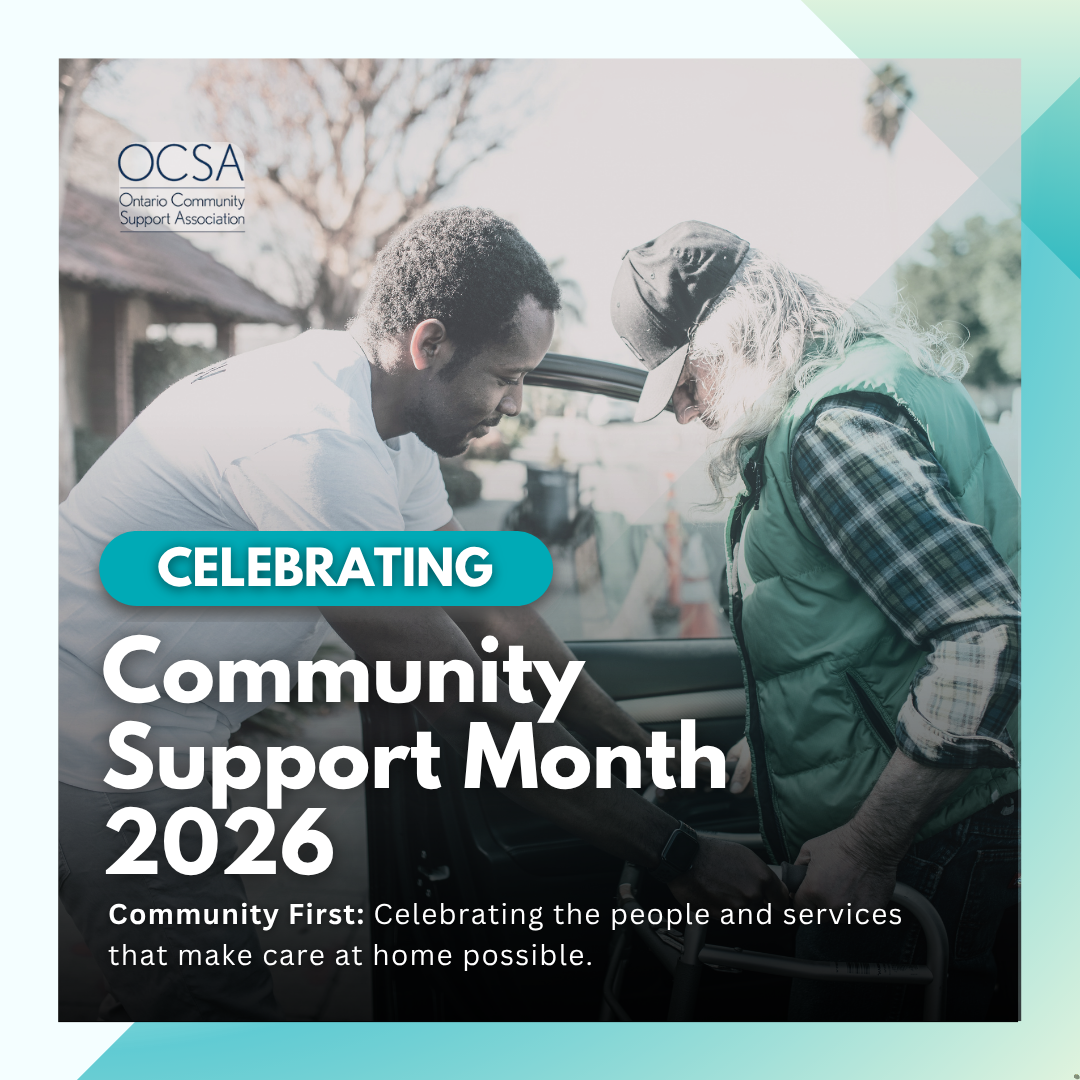
ONTARIO, October 1, 2026 — The Ontario Community Support Association (OCSA) is marking the start of Community Support Month, recognizing the essential services, and the people behind them, that help Ontarians live safely, independently and connected at home and in their communities. This year’s theme, “Community First: Celebrating the people and services that make care at home possible,” highlights the role of community support in helping people live, recover and age in the places they know and where they feel they belong. Across Ontario, not-for-profit organizations provide services such as Meals on Wheels, transportation, adult day programs, assisted living and supportive housing, respite, homemaking, friendly visiting and hospice care. These services support independence and quality of life, help caregivers, and enable people to live safely at home for longer. They also strengthen the health system by helping prevent avoidable emergency department visits and hospital admissions, delaying or avoiding the need for long-term care, and supporting safe transitions home after a hospital stay. “Care at home is made possible by a network of people and services working together every day,” said Lori Holloway, CEO of OCSA. “Community Support Month is an opportunity to recognize that work and the difference it makes for individuals, families and communities across Ontario. It is also a reminder that strong community support is essential to a strong health system.” Community support organizations are deeply rooted in the communities they serve. Staff, volunteers and partners respond to local needs, helping older adults and people with disabilities access practical assistance, social connection and ongoing support. As demand grows and people’s needs become more complex, these organizations face increasing pressures related to funding and workforce capacity. Recognizing their contribution also means supporting their ability to continue delivering the services people rely on. Throughout October, OCSA is encouraging member organizations, community partners and Ontarians to celebrate community support by sharing stories, recognizing staff and volunteers, and highlighting the impact of services delivered at home and close to home. “Behind every meal delivered, ride provided or opportunity for connection are people who make community care possible,” added Holloway. “This month, we celebrate their dedication and invite Ontarians to learn more about the services helping people remain independent, supported and connected.” OCSA invites the public to join the conversation using #CSM2026 and learn more at www.ocsa.on.ca . Media Contact: Karla Sealy Ontario Community Support Association (OCSA) karla.sealy@ocsa.on.ca 416-256-3010 / 1-800-267-6272 ext. 242 About the Ontario Community Support Association (OCSA) The Ontario Community Support Association (OCSA) is the leading voice for home and community care in Ontario, representing hundreds of not-for-profit organizations delivering both home care and community support services across the province. OCSA members provide essential services including nursing, personal support and therapies; Meals on Wheels, transportation, caregiver supports, and other programs that help people remain safely in their homes and communities. Serving over one million Ontarians each year, OCSA works with government and system partners to advance integrated, community-based care as a cornerstone of a sustainable health system.

September, 2026 - Meals on Wheels Ontario is excited to partner with the LCBO on a province-wide fundraising campaign to support food security for seniors and people with disabilities across Ontario. Customers can purchase a reusable LCBO and Meals on Wheels tote bag, designed by Ontario artist Sarah Farquhar, at participating LCBO stores and online . 100% of proceeds from the tote bag campaign will be donated to Meals on Wheels Ontario to provide meals to seniors and people with disabilities. Funds raised through the campaign will help support clients experiencing financial hardship and help reduce barriers to accessing nutritious meals. Looking for a tote bag? Find a participating LCBO store near you. You can also purchase a tote bag online through LCBO. Share your support Picked up a tote bag? We’d love to see it! Share a photo of your tote bag on social media and tag Ontario Community Support Association so we can see and share your campaign moments. See more at MOW and LCBO Tote Campaign | Meals on Wheels | ON
Toronto, ON – June 30, 2026 – Nearly 700 Ontarians are currently waiting in hospital for home care or community support services to be arranged before they can safely return home, according to data available from Ontario Health. The Ontario Community Support Association (OCSA) says the figures demonstrate the growing urgency of investing in the services that make aging at home possible. These findings come as new data from the Canadian Institute for Health Information (CIHI) highlight ongoing emergency department pressures across Canada and as more than 45,000 Ontarians remain on long-term care waitlists in the community. Together, these numbers point to a fundamental shift occurring across Ontario's healthcare system: more people are living longer at home, often with increasingly complex needs, while demand for community-based care continues to outpace available capacity. "Ontario has entered a new era of healthcare," said Lori Holloway, Chief Executive Officer of OCSA. "For years we've talked about aging at home as a goal. Today, it is the reality. More than 45,000 people are waiting for long-term care in the community, and nearly 700 patients are waiting in hospital for the home care and community support services needed to return home safely. The question is no longer whether Ontario needs more community capacity. The question is how quickly we can build it." Ontario's not-for-profit home care and community support organizations provide the services that make aging at home possible, including home care, transportation, Meals on Wheels, assisted living, caregiver supports, adult day programs, wellness services and hospital-to-home programs. Without these supports, seniors are more likely to remain in hospital longer, experience avoidable health crises, or require earlier admission to long-term care. “Community care is increasingly becoming healthcare's pressure valve," said Holloway. "Every hospital bed occupied by someone waiting for community services tells us the same thing: the demand for aging-at-home supports is growing faster than the system's ability to provide them. If we want to improve hospital flow, reduce pressure on emergency departments and help people remain independent longer, we need to accelerate investment in community capacity." OCSA is calling for continued investments in home care, community support services, caregiver supports; not just service volume increases but the necessary infrastructure funding to ensure Ontario can meet the needs of a rapidly aging population. "Ontario has made important investments across hospitals, long-term care and home care," Holloway added. "The next phase of healthcare transformation must focus on building the aging-at-home capacity that will determine whether our health system can meet future demand." For more information: Karla Sealy Manager, Advocacy, Policy and Community Engagement karla.sealy@ocsa.on.ca 416-256-3010/1-800-267-6272, ext. 242

Ontario, Canada — April 1, 2026 — The Ontario Community Support Association (OCSA) and the Ontario SPCA and Humane Society (Ontario SPCA) are launching a new partnership to support seniors and their pets by delivering pet food alongside Meals on Wheels deliveries. This collaboration brings together community support providers and animal welfare services to address a practical challenge faced by many older adults—accessing pet food due to limited mobility, fixed incomes, or transportation barriers. By leveraging existing Meals on Wheels routes, volunteers can now also deliver pet supplies donated by the Ontario SPCA during their regular visits. The initiative is being introduced through an initial pilot with a small group of participating providers, including Meals on Wheels Sudbury, and Meals on Wheels Cornwall, which has already completed its first pet food deliveries to local seniors. “Meals on Wheels programs do far more than deliver food, they are a vital connection point into the community,” said Lori Holloway, CEO of OCSA. “This partnership reflects how organizations can work together to respond to real, everyday challenges seniors face. It’s a practical example of how community-based care supports the whole person, not just clinical needs.” “Pets are family, and we know the positive impact they have on people’s mental and emotional health,” said Jennifer Bluhm, VP, Community Outreach, Ontario SPCA and Humane Society. “This partnership helps remove barriers so seniors can continue to enjoy the companionship of their pets.” The program is already making an impact at the community level, with local providers seeing firsthand how small supports can improve quality of life for clients. “Pets can play a powerful role in reducing the isolation many seniors experience,” said Tammi Lear, Executive Director, Meals on Wheels Sudbury. “Meals on Wheels Sudbury is excited to partner with the Ontario SPCA and Humane Society to help keep our seniors healthy, connected, and able to remain in their homes with their pets.” “Meals on Wheels Cornwall is proud to be the first organization to pilot this program with the Ontario SPCA,” said Andree-Ann Morin, Meals on Wheels Coordinator, Glen Stor Dun Lodge. “This pilot program recognizes that food security doesn’t stop with the individual — it includes the pets who bring comfort and companionship. Thanks to the Ontario SPCA, we’ve already been able to help clients who were struggling with the cost, access, and special dietary needs of their pets. Even with just a few clients so far, we’ve seen how removing this worry can improve overall wellbeing.” Evidence shows that pets can reduce loneliness and support mental well-being among older adults. Small, practical supports like this can play an important role in maintaining health, preventing more complex needs over time, and improving client outcomes. This new partnership demonstrates the potential of cross-sector collaboration to better support seniors aging at home, while strengthening connections between health, community, and social supports. OCSA and the Ontario SPCA will continue working together to explore opportunities to expand the program with additional community partners across Ontario. Media Contact: Karla Sealy Ontario Community Support Association (OCSA) karla.sealy@ocsa.on.ca 416-256-3010 / 1-800-267-6272 ext. 242 About the Ontario Community Support Association (OCSA) The Ontario Community Support Association (OCSA) is the leading voice for home and community care in Ontario, representing hundreds of not-for-profit organizations delivering both home care and community support services across the province. OCSA members provide essential services including nursing, personal support and therapies; Meals on Wheels, transportation, caregiver supports, and other programs that help people remain safely in their homes and communities. Serving over one million Ontarians each year, OCSA works with government and system partners to advance integrated, community-based care as a cornerstone of a sustainable health system. About the Ontario SPCA and Humane Society The Ontario SPCA and Humane Society is a registered charity that has been operating for more than 150 years. The organization provides care, comfort, and compassion to animals in need in communities across Ontario, and works to keep pets and people together through a variety of community support services, education, and animal wellness initiatives.
Ontario, March 27, 2026 — The Ontario Community Support Association (OCSA) welcomes the Ontario government’s continued investment in home care and community support services as part of the 2026 provincial budget. Building on recent commitments, this investment signals a sustained shift toward strengthening care in the home and community as a central pillar of Ontario’s health system. As demand continues to grow—driven by an aging population, increasing caregiver strain, and sustained pressure across hospitals and long-term care—expanding access to care outside of institutions is critical to improving system flow and long term sustainability. “We are listening closely to what Ontarians are telling us—and so is the government,” said Lori Holloway, CEO of OCSA. “People want to receive care at home and in their communities, surrounded by the people and supports that matter most. This investment reflects that reality and moves us further toward a system designed around where people actually want and need care.” Home care and community support services each play distinct but complementary roles. Home care provides essential clinical and personal care in the home, while community support services focus on prevention, independence, and quality of life through programs such as Meals on Wheels, transportation, adult day programs, and caregiver respite. Together, they form the foundation of a modern, community-based care system that helps people remain at home longer while reducing avoidable hospital use and delaying or preventing long-term care placement. This level of sustained investment has the potential to significantly expand access to care at home, strengthen community capacity, and improve outcomes for individuals and families across the province—while supporting a more balanced and sustainable health system overall. OCSA is committed to working with government and system partners to ensure these investments translate into real improvements in access, stronger community supports, and measurable impact for Ontarians. You can access OCSA's pre-budget submission here. About OCSA The Ontario Community Support Association represents more than 200 not-for-profit organizations providing home care and community support services across the province. OCSA members deliver essential services that help people live independently, age at home, and reduce pressure on hospitals and long-term care. For media inquiries please contact: Karla Sealy (she/her) Manager of Communications 416-256-3010/1-800-267-6272, ext 242 karla.sealy@ocsa.on.ca
OCSA in the News
"Enhanced Assisted Living Expansion in Ontario” report also calls for government support to expand unique models of care.
ONTARIO, October 1, 2026 — The Ontario Community Support Association (OCSA) is marking the start of Community Support Month, recognizing the essential services, and the people behind them, that help Ontarians live safely, independently and connected at home and in their communities. This year’s theme, “Community First: Celebrating the people and services that make care at home possible,” highlights the role of community support in helping people live, recover and age in the places they know and where they feel they belong. Across Ontario, not-for-profit organizations provide services such as Meals on Wheels, transportation, adult day programs, assisted living and supportive housing, respite, homemaking, friendly visiting and hospice care. These services support independence and quality of life, help caregivers, and enable people to live safely at home for longer. They also strengthen the health system by helping prevent avoidable emergency department visits and hospital admissions, delaying or avoiding the need for long-term care, and supporting safe transitions home after a hospital stay. “Care at home is made possible by a network of people and services working together every day,” said Lori Holloway, CEO of OCSA. “Community Support Month is an opportunity to recognize that work and the difference it makes for individuals, families and communities across Ontario. It is also a reminder that strong community support is essential to a strong health system.” Community support organizations are deeply rooted in the communities they serve. Staff, volunteers and partners respond to local needs, helping older adults and people with disabilities access practical assistance, social connection and ongoing support. As demand grows and people’s needs become more complex, these organizations face increasing pressures related to funding and workforce capacity. Recognizing their contribution also means supporting their ability to continue delivering the services people rely on. Throughout October, OCSA is encouraging member organizations, community partners and Ontarians to celebrate community support by sharing stories, recognizing staff and volunteers, and highlighting the impact of services delivered at home and close to home. “Behind every meal delivered, ride provided or opportunity for connection are people who make community care possible,” added Holloway. “This month, we celebrate their dedication and invite Ontarians to learn more about the services helping people remain independent, supported and connected.” OCSA invites the public to join the conversation using #CSM2026 and learn more at www.ocsa.on.ca . Media Contact: Karla Sealy Ontario Community Support Association (OCSA) karla.sealy@ocsa.on.ca 416-256-3010 / 1-800-267-6272 ext. 242 About the Ontario Community Support Association (OCSA) The Ontario Community Support Association (OCSA) is the leading voice for home and community care in Ontario, representing hundreds of not-for-profit organizations delivering both home care and community support services across the province. OCSA members provide essential services including nursing, personal support and therapies; Meals on Wheels, transportation, caregiver supports, and other programs that help people remain safely in their homes and communities. Serving over one million Ontarians each year, OCSA works with government and system partners to advance integrated, community-based care as a cornerstone of a sustainable health system.
September, 2026 - Meals on Wheels Ontario is excited to partner with the LCBO on a province-wide fundraising campaign to support food security for seniors and people with disabilities across Ontario. Customers can purchase a reusable LCBO and Meals on Wheels tote bag, designed by Ontario artist Sarah Farquhar, at participating LCBO stores and online . 100% of proceeds from the tote bag campaign will be donated to Meals on Wheels Ontario to provide meals to seniors and people with disabilities. Funds raised through the campaign will help support clients experiencing financial hardship and help reduce barriers to accessing nutritious meals. Looking for a tote bag? Find a participating LCBO store near you. You can also purchase a tote bag online through LCBO. Share your support Picked up a tote bag? We’d love to see it! Share a photo of your tote bag on social media and tag Ontario Community Support Association so we can see and share your campaign moments. See more at MOW and LCBO Tote Campaign | Meals on Wheels | ON
Members Bulletin
Our monthly e-newsletter provides updates from OCSA, upcoming member events and programs, the month's top news stories, job postings and much more.
SUBSCRIBE TO OCSA'S BULLETIN
Media Contact
To arrange an interview or request a comment, please contact:
Karla Sealy
Manager of Communications
karla.sealy@ocsa.on.ca
416-256-3010
1-800-267-6272, ext. 242
or
Janice Bedore
Executive Assistant
416-256-3010
1-800-267-6272, ext. 224

Lori Holloway - CEO
Lori Holloway brings a wealth of experience and a deep commitment to Ontario’s home and community care sector. She has led with purpose across the community, charitable, and healthcare sectors, grounded in a passion for person-centred, community-based care.
Lori holds a Bachelor’s in Physical Education, an MBA, and has pursued post-graduate studies in Gerontology and Volunteer Management. Her career has been defined by a passion for innovation, equity, and collaboration in home and community care. Lori is known for building strong partnerships, driving strategic change, and championing services that meet the unique needs of diverse communities.
